Showing posts with label Avamar. Show all posts

Wednesday, August 30, 2017

Slow backup Issue

Networker slow backup issue

We are facing slow backup issue many times or previously added clients suddenly slow backup issue occurs. This is either because of Network glitch at server end and on client side or configuration issue at both ends.

Scenario 1:

Network End: -

Below points should always be taken care off:

·         You should be always aware about link speed between your backup server and backup clients
·         Any network or data capped is configured as switch end
·         All network cards and switches have the same Duplex, Speed, MTU and other settings
·         Also, check latency between your backup server and backup client
·         Analyze network performance or problems with netstat

Scenario 2:

Client End: -

Below points should always be taken care off:

·         Check data size and number of files in your drives (hundred thousand or millions) of small files.
·         If you have small size huge files, then backup speed will be automatically degrading. (If you have D drive with 100 GB and 400 files but you have other drive E with 50 GB and 5000000…then E will take more time to backup)
·         Defragmented disk drives
·         Make sure that the OS is up-to-date with latest patches
·         Also, check the load on server with Task Manager
  •             Networker should be up to date with latest version

·         Reboot the NetWorker server, client, and storage node operating systems.

Scenario 3:

Backup Server End: -

Below points should always be taken care off:

·         Check if any Index is corrupted
·         Check if any defunct or zombie process is related to that client
·         Check if check point enabled, disabled if not require (for file server and huge data backup it should be enable so if save fails, it can be restarted from the point of interruption). This setting is tricky you will decide as per your data type.
·         Monitor and check the device write speeds over time through NetWorker debug mode
  •                  Ensure enough hardware resources (that is, tape drives) are available to handle the load.
  •                 Networker should be up to date about version
  •                Also, check Device configuration in terms of device session max session and target session

·         With help of nsrinfo command check the what kind of data backing up on your environment (Database, any other ongoing application). If you are taking flat file system backup with ALL save set, then you should be alert about any database or SharePoint or ongoing file access application data backup.

·         If you are backing up SQL/DB/MYSQL/SharePoint server backup using ALL save set and without any respective module (means your database backup are take care differently other than Networker) and it will be taking long time to backup up the data. Here you should mention save set of backup if you do not want to backup the any DB/Application servers (with Module)

·         Rebooted the NetWorker server, client, and storage node operating systems


Note : While trouble shooting the slow backup issue you should always coordinate with Network/Server admin and also historical logs should be checked.

Tuesday, May 30, 2017

How to configure the Avamar Event notifications

Today we are go through with how to configure Avamar alert Notification :-


A.      Log into the Avamar Server using the Avamar Administrator.

B.      In the toolbar of the Avamar Administrator, select Tools -> Manage Profiles.  A new window "Manage All Profiles" will open.


C.      Click the New button in the top left corner of the Manage All Profiles window to bring up the New Profile window.

 Or you can select any preconfigured profile and copy it


D.      Enter a Profile Name.


Example: Avamar Alert Notifications


E.       Ensure the Profile checkboxes for 'Enabled' and 'Email Enabled' are both checked.


F.       Ensure that the option  Send data as events occur  is selected.

G.      Uncheck the enabled check boxes for "Syslog Notification" and "SNMP Trap Notification."

H.      Click Next to go to Event Codes window.

I.         Click the Clear button to remove all default codes.

J.        Select the codes which an notifications should be received for a given event.

K.         Click Next.

L.       Ensure that both the  Attach Server status in email (XML)  and  Attach Server log(s) in mail  check boxes are not checked.

M.    Click Next to go to the Email Notification window.

N.      Update the Email Subject Header to reflect the purpose of the email. eg  Avamar Notifications. 

O.      In the  Enter Recipient:  text box, enter the email address to send the email notifications to (eg. avma.test@test.com) and click the + button.  If required, multiple email addresses may be entered.

P.       Click Finish.


Q.     Select the new Profile and review the settings to ensure they are correct.

R.      Monitor email to ensure receipt of selected events.


Note:- For more info please go through Avamar admin guide as well as EMC website.

http://www.support.emc.com


Saturday, April 29, 2017

Avamar Event Notification

All Avamar system activity and operational status is reported as events to the MCS. Examples of Avamar events include client registration and activation, successful and failed backups, and hard disk status, power supply failure, Any kind of activity failed/successful.

When any kind of event occurred, following features will generates: -

Pop-up alerts: -

You can configure individual events to generate a graphical pop-up alert each time the event occurs.

Acknowledgement required list: -

You can specify that when a certain event type occurs, the Avamar system administrator must acknowledge the event.


Email Messages: -

You can specify that when a certain event type occurs, an email message is sent to a selected list of recipients. Email notifications can be sent immediately or in batches at scheduled times.

Syslog Support: -

You can specify that when an event type occurs, Avamar logs information to local or remote syslog files based on filtering rules configured for the syslog daemon that receives the events.

Third-party monitoring tools and utilities capable of examining log entries can access the syslog files and process them to integrate Avamar event information into larger site activity and status reports.

SNMP Support: -

The Avamar SNMP implementation provides two ways to access Avamar server events and activity completion status:

SNMP requests provide a mechanism for SNMP management applications to “pull” information from a remote SNMP-enabled client (in this case, the Avamar server).

SNMP traps provide a mechanism for the Avamar server to “push” information to SNMP management applications whenever designated Avamar events occur. You can
configure an event type to output SNMP traps.

Event Profiles: -

Profiles are a notification management feature that are used to logically group certain
event codes together and specify which notifications to generate when the events occur.

There are two basic types of event profiles:

System profile — There is only one system event profile. It contains all possible
system event codes.

Custom profiles — You can create as many custom profiles as you need to
organize system events and generate notifications when any of those events occur.

Profile Catalog: -

The Avamar system contains a set of preconfigured event profiles by default.

System Profile: -

There is only one system event profile. It contains all possible system event codes.

Evaluation Profile: -

If this profile enabled, this profile generates an email notification and attaches two weeks’ worth of
Activities - DPN Summary report information to the email message.

High Priority Events Profile:-

This special event profile automatically emails the following information to EMC Customer Support (emailhome@avamar.com) twice daily:

Status of the daily data integrity check

Selected Avamar server warnings and information messages

l Any Avamar server errors

The High Priority Events profile is enabled by default. The only change you can make to the High Priority Events profile is to add email addresses to the Recipient Email List. If you require custom High Priority Events profile settings, copy the profile and then edit the copy. We will see in next article.

Local SNMP Trap Profile: -

The profile enables you to verify that traps are successfully generated and received by the local snmptrapd process, which then writes the trap information to a syslog file. The Local SNMP Trap profile is read-only and is intended to be used for test purposes
only.

Local Syslog Profile: -

The Local Syslog profile reports status by way of the local syslogd process on the Avamar server.


Note: - for more information you should check EMC site and admin documents.

Tuesday, February 28, 2017

NDMP FH - File History space and memory requirements

While an NDMP backup, the NDMP Data Server (NAS server) sends the file history CatLog or metadata information to the NetWorker server. FH metadata which is received from the NAS does not verify or modify by NetWorker software.

The NetWorker uses the FH information to maintain proper indexes and media database entries for the NDMP client backups.

Instead of virtual memory, the binaries nsrndmp_2fh and nsrdmpix are interact with the raw database. As a result, memory requirements for this process are nominal.

The NetWorker server stores metadata updates in the \nsr\tmp directory and commits the metadata to the client file index after the NDMP client backup completes.

Use the following formula to determine the required physical space for the default \nsr\tmp directory:

2 * (144 + average file name length) * number of entries in the file system

Please Note below thing: -

This formula must be used for non-multi-streaming only.

For example:

For one million file entries with an average file name length of 128, use this formula to
compute the required temporary swap space:


2 * (144 + 128) * 1,000,000 = 544 MB approximately

Monday, January 30, 2017

NetWorker client file index database Size

For the NetWorker client file index database (nsr/index): The number of files
indexed and in the browse policy. This is normally the largest of the NetWorker
databases. For storage sizing, use this formula:


Index catalog size = {[(F+1)*N] + [(I+1) * (DFCR*N)]} * [(1+G)*C]


where:

F = 4 (Full Browse Period set to 4 weeks)

N = 1,000,000 (one million files for this example)

I = 24 (A four week browse period for incremental backups - minus the full backups)

DFCR = 3% (Daily file change rate for standard user file data)

G = 25% (estimated annual growth rate %)

C = 160 bytes (Constant number of bytes per file)

For example:

{[(4+1)*1,000,000] + [(24+1) * (3%*1,000,000)]} * [(1+.25)*160]

{5,000,000 + [25 * 30,000)} * [1.25 * 160]

5,750,000 * 200 bytes

= 1,150,000,000 bytes

= 1150 MB


Saturday, November 26, 2016

RPC error: RPC program or version mismatch

We have looking today for RPC error: RPC program or version mismatch

There is a mismatch between the version of the Remote Procedure Call (RPC) service requested by the client and the service available on the server. 

This problem might be the result of an incorrect "Name to Address" resolution. 

There is a mismatch between the version of the RPC service used by the License Manager (lgtolmd) and the services available on the server. The default RPC version for lgtolmd is two.

Use rpcinfo to verify that the server and the clients are running the same version of RPC. For operating systems without the rpcinfo utility, it is provided on the EMC product CD.

Update the NetWorker software on the client or server.

Verify that the "Name to Address" resolution is correct. Test by running nslookup using the fully qualified domain name of the computer. On Windows systems, this verification also can be performed from the Network control panel.

Specify the same version of RPC for lgtolmd that is used by the other backup services on the backup server. This can be specified by either:

Entering the following command at the command line:

# lgtolic -s hostname:rpc_number:rpc_version


Setting the LMD_VERSION environment variable.

Thursday, September 8, 2016

EMC NetWorker backup logs files paths and details for Windows

Hi,

Today here I would like to provide details of the log files available on a Windows Networker server and log
file management.

Windows Networker Server Log Files:-


Windows NMC Server Log files:


Windows Networker client Log Files:-


There is two types of logs files:

*.log >> It is plan text file and human readable
*.raw>> It is not human readable format


You can view manually raw files with help of nsr_render_log Networker command.
You can also set it in runtime with help of nsradmin and "update runtime rendered log" Networker configuration commands.

The nsr_render_log send the output result to stdout

You can also rollover the files by time and size with help of below commands:

nsradmin
update runtime rollover by time
update runtime rollover by size


Thanks


Tuesday, August 30, 2016

EMC NetWorker backup logs files paths and details for Unix/Linux

Hi,

Today here I would like to provide details of the log files available on a Unix Net-worker server and log
file management.

Networker Server Log Files:-


Networker Server Log Files:-


Networker Client Log files:-


There is two types of logs files:


*.log >> It is plan text file and human readable
*.raw>> It is not human readable format


You can view manually raw files with help of nsr_render_log Networker command.
You can also set it in runtime with help of nsradmin and "update runtime rendered log" Networker configuration commands.


The nsr_render_log send the output result to stdout


You can also rollover the files by time and size with help of below commands:


nsradmin
update runtime rollover by time
update runtime rollover by size


Thanks

Thursday, June 30, 2016

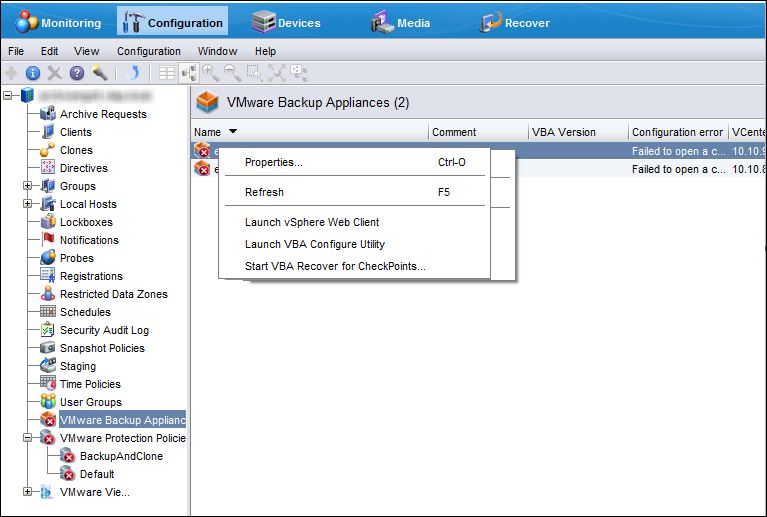
How to Delete VBA Node in Networker

How to Delete VBA Node in Networker

Networker Ver: 8 to 9

If you want to remove VBA node entirely and delete it's backups from Networker server. The VBA node is online and responding to request from Networker server. Before Doing anything please consult with EMC Support for Assistance because VBA Node delete/remove is not recommended by EMC as a troubleshooting step.

Before starting any critical configuration you should take first backup of nsrdb and mm directories (Particular directory which related with that configuration)

Connect to Networker backup server and open the following directory

 <networker-install>\nsr

e.g   
·         Unix: /nsr/ 
·         Windows C:\Program Files\EMC NetWorker)

Make a copy of the following directories:

res\nsrdb
res\mm

After successfully copied mentioned directories you can start your actual configuration.

Remove all save sets for the client-id for this VBA node

List the Saveset:

mminfo  –c  <vba-name>  -kot

Remove Saveset:

nsrmm -d -S <SSID>

If the VBA is NOT online, then use the -X option to delete the Save set:

nsrmm -X -d -S <SSID>

Remove all workflows associated with the VBA and Delete VBA Mtree

Using GUI (NMC):

1. Login to NMC

2. Go to Configuration tab and click VMware Protection Policies

3. Sort the policies by VBA List

4. Open the first policy that has this VBA listed, go to VMware Backup Appliance Selection      tab and uncheck the VBA name.

5. Wait for the State column to change to Success


Using CLI (nsradmin):

nsradmin> p type: nsr hypervisor; name: <vcenter-name>
nsradmin> Delete

Remove VBA server resource using nsradmin

 d type: NSR VBA Server; name: <vba>

Note: This step may need to be done using offline nsradmin if VBA is NOT responding

Delete the VBA Appliance Delete the relevant VBA node VM from the vCenter server

On the NetWorker server, run nsradmin command utility to find the VBA DPN ID:

nsradmin> show name

nsradmin> show DPN ID

nsradmin> p type: nsr vba server; name: VBA-FQDN

To delete the storage unit on Data Domain:

Login to Data Domain as Admin and run command,

ddboost storage-unit delete <storage-unit>

Clean file system if required using command, filesys clean start


If the External proxy is no longer needed delete the external proxy virtual machine

Tuesday, May 31, 2016

How to check validcopies in NetWorker 9 with mminfo

How to check validcopies in NetWorker 9 with mminfo:

In your backup environment data clone going to a disk media, I suspect that we are rarely will see a save set with clflg mminfo attributes. The reason is that 'faulty/aborted' save sets will automatically be deleted.

If you want to know whether a save set has successfully been cloned you better check with 'validcopies' mminfo attribute:


mminfo -r "client,name,ssid,validcopies,pool"

or to verify all save sets with only one copy

mminfo -q "validcopies<2" -r "client,name,ssid,validcopies,pool"

Sunday, February 7, 2016

EMC ELECT 2016

Friends I would like to share that I am elected as EMC Elect 2016 with another 70 experts from 150 finalists.

Below is the link for your reference to see the list of elected candidates


This is a very funny incident with me about EMC elect. When I started working on EMC product and I heard from someone that there is one kind of election EMCElect. I was very surprised because I thought EMC is also conducting election like politicians  but after reading about EMC Elect I got to know that this is an honor for EMC expertise.

So that time I was very excited to grab much information about EMC Elect. I always share my knowledge regularly on EMC Community Network, sharing on Twitter too. I also started sharing my technical tips through blogs and on EMC community forum for knowledge sharing.

I was shortlisted For EMC ELECT 2013 but was not selected, and I took it as a challenge and I said to myself that next time I will take more efforts and again participate in 2014 and finally I got first EMC honor in 2014 and again in 2016.

I would like to thanks all who voted me and fulfil to complete this program.

This is unique initiative by EMC and I am really enjoying to participate year again year.

Special thanks to Mark Browne ‏@DathBrun and all known unknown people who were involved in this activity.

Tuesday, February 2, 2016

VSS System Writer is not found on this system

The VSS System Writer is not found on this system:

While backing up Windows 2008 and 2012 server on EMC Networker and you are getting below error, there will be many causes for this error. This is a very common permission issue.


98266:save: The VSS System Writer is not found on this system.  The backup is stopping because the System Writer is required for a successful system state backup.  Have the system administrator check the VSS infrastructure and fix the issue.

You should first try below solution:

Start or Restart below services:

1. COM+ Event System
2. COM+ System Application
3. Distributed Transactions Coordinator
4. Microsoft Software Shadow Copy Provider
5. Volume Shadow Copy service
6. Networker remote exec service

And try to take test backup, if it fails again then you should go with below Microsoft solution.

The system writer fails because permissions to files in the %windir%\winsxs\filemaps\ or %windir%\winsxs\temp\PendingRenames directories are incorrect.

Solution:
To resolve this issue, type the following commands from an elevated command prompt:
Takeown /f %windir%\winsxs\temp\PendingRenames /a
icacls %windir%\winsxs\temp\PendingRenames /grant "NT AUTHORITY\SYSTEM:(RX)"
icacls %windir%\winsxs\temp\PendingRenames /grant "NT Service\trustedinstaller:(F)"
icacls %windir%\winsxs\temp\PendingRenames /grant BUILTIN\Users:(RX)
Takeown /f %windir%\winsxs\filemaps\* /a
icacls %windir%\winsxs\filemaps\*.* /grant "NT AUTHORITY\SYSTEM:(RX)"
icacls %windir%\winsxs\filemaps\*.* /grant "NT Service\trustedinstaller:(F)"
icacls %windir%\winsxs\filemaps\*.* /grant BUILTIN\Users:(RX)


net stop cryptsvc
net start cryptsvc


Type the following command to verify that the system writer is now listed: vssadmin list writers


If the system writer is missing, check the Application event log for the following event

for more info check Microsoft Technical Tips :

https://support.microsoft.com/es-ar/kb/2009272#/es-ar/kb/2009272


Slow backup Issue

Networker slow backup issue We are facing slow backup issue many times or previously added clients suddenly slow backup issue occurs. ...